The Rhizosphere Microbiome Revolution: Leveraging Microbial Potential for Climate Resilience in Agriculture Systems and Modulating Positive Plant-soil Feedback
Muhilan, G
*

Department of Soil Science & Agricultural Chemistry, Agricultural College and Research Institute, TNAU, Coimbatore, 641 003, India.
Bagavathi Ammal, U
Department of Soil Science & Agricultural Chemistry, Pandit Jawaharlal Nehru College of Agriculture and Research Institute, Nedungadu Post, Karaikal 609 603, India.
Pushpakanth, P
Department of Plant Pathology (Agricultural Microbiology), Pandit Jawaharlal Nehru College of Agriculture and Research Institute, Nedungadu Post, Karaikal 609 603, India.
Rajakumar, R
Department of Soil Science & Agricultural Chemistry, Pandit Jawaharlal Nehru College of Agriculture and Research Institute, Nedungadu Post, Karaikal 609 603, India.
Elavarasi, P
Department of Soil Science & Agricultural Chemistry, Agricultural College and Research Institute, TNAU, Coimbatore, 641 003, India.
Leninbabu K. P
Department of Soil Science & Agricultural Chemistry, University of Agricultural Sciences, Gandhi Krishi Vignana Kendra, Bangalore, Karnataka 560 065, India.
Gandhimathi, R
Department of Soil Science & Agricultural Chemistry, Sri Manakula Vinayagar College of Agriculture, SMVEC, Madagadipet, Puducherry 605 107, India.
Venkatesan, V.G
Department of Soil Science & Agricultural Chemistry, Pandit Jawaharlal Nehru College of Agriculture and Research Institute, Nedungadu Post, Karaikal 609 603, India.
*Author to whom correspondence should be addressed.
Abstract
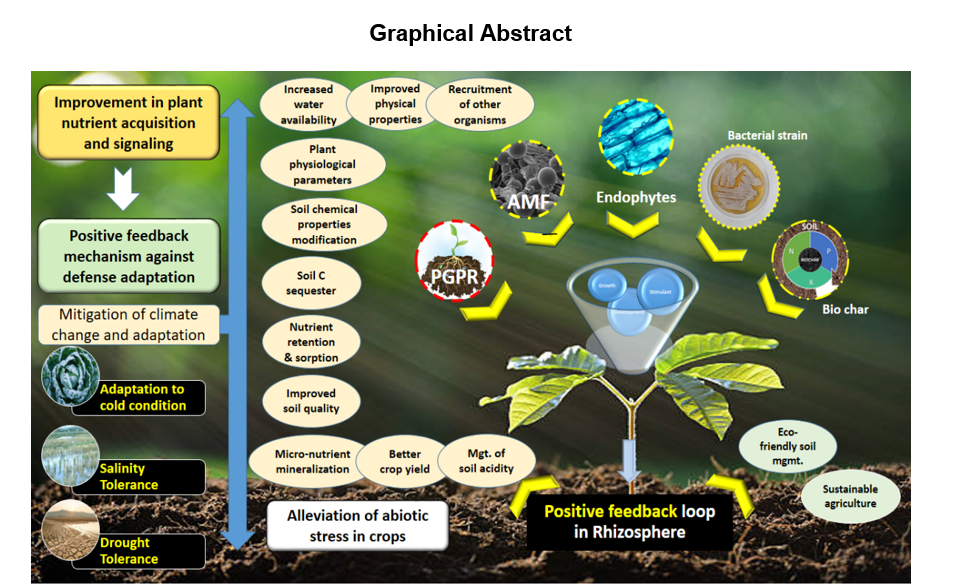
The living soil system plays a crucial role in sustainable agricultural production, with soil quality serving as a key indicator of environmental stability, food security, and economic viability. However, in recent years, soil health has been abruptly decreases due to unstable management practices and climatic challenges such as drought, salinity, and unpredictable weather patterns. To restore and maintain soil fertility for future food security, the use of natural soil organisms, particularly microbes, is essential. Soil microorganisms significantly contribute to nutrient mobilization, solubilization, and improved nutrient availability for plants. The rhizosphere, a dynamic zone around plant roots, is the hotspot of intense biological and biochemical interactions among microbes and plants, influencing soil biodiversity, disease suppression, and soil physicochemical properties. Microbes act as sensitive indicators of soil health due to their rapid response to environmental changes and their integral role in soil processes. Beneficial microorganisms like plant growth-promoting rhizobacteria (PGPR) and arbuscular mycorrhizal fungi (AMF) not only enhance crop productivity but also improve plant tolerance to abiotic stresses such as drought and salinity. Additionally, microbial communities contribute to soil structural stability by forming aggregates, enhancing water retention, and facilitating organic matter dynamics. These plant-microbe interactions are vital for promoting crop growth, managing diseases, and achieving sustainable agriculture without harming ecosystem functions. Future research should focus on identifying effective microbial strains and understanding microbial metabolites that influence plant-soil interactions. This review highlights the crucial role of microorganisms in improving soil health and supports their potential application in advancing sustainable agricultural practices.
Keywords: microorganisms, microbial community, rhizosphere, soil health