Extraction and Characterisation of Cellulose of Chrysophyllum albidum (African Star Apple) Fruit Waste Using Infrared Spectroscopy
Unwana Isaac Akpan *
Department of Pure and Industrial Chemistry, University of Port Harcourt, East-West Road, Choba, PMB 5323, Port Harcourt, Nigeria.
Leo C. Osuji
Department of Pure and Industrial Chemistry, University of Port Harcourt, East-West Road, Choba, PMB 5323, Port Harcourt, Nigeria, World Bank Africa Centre of Excellence for Oilfield Chemicals Research, University of Port Harcourt, Choba, PMB 5323, Port Harcourt, Nigeria and Institute of Natural Resources, Environment and Sustainable Development, University of Port Harcourt, Choba, PMB 5323, Port Harcourt, Nigeria.
Abosede O. James
Department of Pure and Industrial Chemistry, University of Port Harcourt, East-West Road, Choba, PMB 5323, Port Harcourt, Nigeria and World Bank Africa Centre of Excellence for Oilfield Chemicals Research, University of Port Harcourt, Choba, PMB 5323, Port Harcourt, Nigeria.
*Author to whom correspondence should be addressed.
Abstract
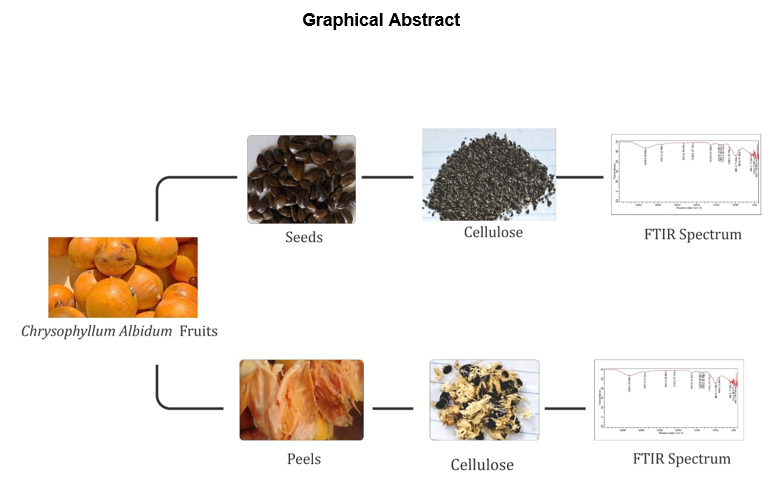
The growing demand for plastics in daily applications has intensified concerns about plastic pollution due to their non-biodegradable nature. Cellulose, the most abundant biopolymer in nature, offers great promise as a renewable and biodegradable material. Traditionally, cellulose is sourced from wood and cotton, but recent studies have shifted toward agricultural wastes to reduce competition with food resources and enhance circular economy practices. This has created an urgent need for sustainable alternatives such as bioplastics derived from renewable, non-food feedstocks. To address this challenge, the present study investigates the potential of Chrysophyllum albidum (African star apple) fruit waste, seeds and peels, as a cellulose source for bioplastic production, thereby avoiding competition with food resources. Cellulose was extracted from the seeds and peels using the Kraft pulping method and characterized by Fourier Transform Infrared Spectroscopy (FTIR). The FTIR spectra confirmed the presence of characteristic cellulose functional groups in both seed- and peel-derived samples. Comparative yield analysis showed that 29.2 g of seeds produced 38% cellulose, whereas the same mass of peels yielded 8.6%. These results were consistent across multiple extraction batches, indicating the reliability of the process. The findings demonstrate that the seeds of C. albidum provide a significantly higher cellulose yield than the peels, establishing them as a more viable and productive feedstock for bioplastic development. This study highlights the potential of underutilized agro-waste in advancing sustainable materials while mitigating both plastic pollution and food insecurity concerns. These findings establish the seeds of C. albidum as a more reliable and productive feedstock for cellulose-based bioplastic production compared to the peels. Importantly, since both seeds and peels are by-products and not staple food sources, their utilization does not pose any risk of food insecurity. Instead, it promotes the valorisation of agricultural waste and contributes to the advancement of eco-friendly alternatives to synthetic plastics. Future research should investigate the conversion of this cellulose into bioplastics and assess its mechanical, thermal, and biodegradability properties to fully establish its industrial potential.
Keywords: Cellulose, bioplastic, Chrysophyllum albidum fruits, biodegradable, seeds, peels