Transethosomes for Rheumatoid Arthritis Therapy: A Promising Drug Delivery System
Shubham Bhauso Patil *
Dr J.J.Magdum College of Pharmacy Jaysingpur Kolhapur, Maharashtra, India.
Shravani Sudhir Kharade

Dr J.J.Magdum College of Pharmacy Jaysingpur Kolhapur, Maharashtra, India.
Shravani Sarvajeet Kadam
Dr J.J.Magdum College of Pharmacy Jaysingpur Kolhapur, Maharashtra, India.
Shreya Gajanan Kamble
Dr J.J.Magdum College of Pharmacy Jaysingpur Kolhapur, Maharashtra, India.
Shrejal Kiran Chougule
Dr J.J.Magdum College of Pharmacy Jaysingpur Kolhapur, Maharashtra, India.
Shraddha Ravindra Takale
Dr J.J.Magdum College of Pharmacy Jaysingpur Kolhapur, Maharashtra, India.
*Author to whom correspondence should be addressed.
Abstract
Background: Rheumatoid arthritis (RA) remains a major global health burden affecting approximately 0.5-1% of the adult population. Current disease-modifying antirheumatic drug (DMARD) therapies, including methotrexate and biologic agents, demonstrate limited bioavailability, inadequate synovial tissue penetration, and dose-limiting systemic toxicity, resulting in suboptimal disease control in 30-40% of patients. The synovial-blood barrier restricts drug delivery to affected joints, necessitating higher systemic doses that increase hepatotoxicity, bone marrow suppression, and gastrointestinal complications.
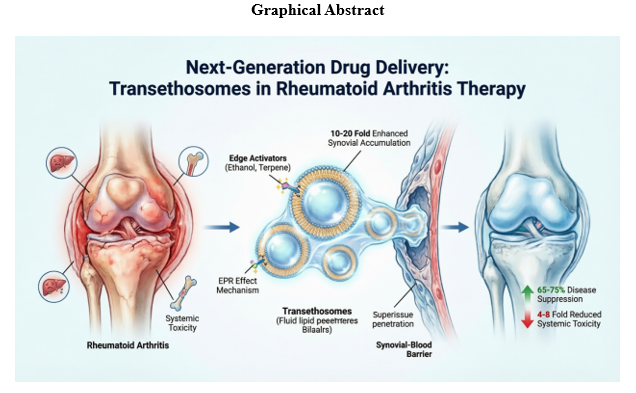
Introduction: Transethosomes represent an innovative nanotechnology-based delivery system combining deformable lipid vesicles with edge activators (ethanol, terpenes) to overcome biological barriers. These elastic nanovesicles demonstrate 2-3fold superior deformability compared to conventional liposomes, enabling enhanced tissue penetration and cellular uptake while preferentially targeting inflamed synovial tissue through enhanced permeability and retention (EPR) effect mechanisms.
Methodology: This comprehensive review synthesizes preclinical and emerging clinical evidence on transethosomal formulations for RA through systematic analysis of in vitro studies, ex vivo tissue models, in vivo animal models (collagen-induced arthritis, adjuvant-induced arthritis), and early-phase clinical development data. Comparative analysis with alternative delivery systems (liposomes, niosomes, micelles, nanoparticles) and future perspectives on clinical translation were evaluated.
Results: Preclinical studies demonstrate that methotrexate-loaded transethosomes achieve 65-75% disease suppression at 0.5-1.0 mg/kg intra-articular dose, compared to 25-35% with free MTX at equivalent doses and 40-50% with conventional liposomes. Transethosomes reduce systemic MTX exposure 4-8 fold (Cmax: 1.5-2.5 μM vs. 8-12 μM for free MTX), dramatically reducing hepatotoxicity risk while enhancing synovial tissue accumulation 10-20 fold. Cellular uptake studies show 3-5 fold higher transethosomal internalization compared to conventional liposomes. Superior intracellular drug bioavailability enables 2-5 fold enhanced anti-inflammatory efficacy.
Conclusion: Transethosomes represent a genuine technological advancement addressing fundamental limitations of conventional RA therapeutics. The combination of superior efficacy, dramatically reduced systemic toxicity, and potential for non-invasive administration (topical/transdermal/oral) positions transethosomes as transformative next-generation RA therapy. Realistic clinical availability is anticipated within 4-6 years, with substantial potential to improve outcomes for millions of RA patients globally.
Keywords: Transethosomes, rheumatoid arthritis, drug delivery, deformable vesicles, enhanced permeability and retention (EPR)