Hydrogeological Parameters and Climate Variability Impacts on Groundwater Availability in M’Bahiakro (Central-East Côte d’Ivoire)
BAÏ Ruth
*

Unit Training and Research in Earth Sciences and Mining Resources, Félix Houphouët- Boigny University, Abidjan, Ivory Coast and Swiss Center for Scientific Research of Ivory Coast, Abidjan, Ivory Coast.
N’CHO Achié Hervé
Unit Training and Research in Science and Environment Management, University Nangui Abrogoua, Abidjan, Ivory Coast.
SANTE Natacha
Unit Training and Research in Science and Environment Management, University Nangui Abrogoua, Abidjan, Ivory Coast.
KONAN Kouakou Séraphin
Unit Training and Research in Science and Environment Management, University Jean Lorougnon Guédé, Ivory Coast.
KOUASSI Kouakou Lazare
Unit Training and Research in Science and Environment Management, University Jean Lorougnon Guédé, Ivory Coast.
KOUAME Kouassi Innocent
Unit Training and Research in Science and Environment Management, University Nangui Abrogoua, Abidjan, Ivory Coast.
*Author to whom correspondence should be addressed.
Abstract
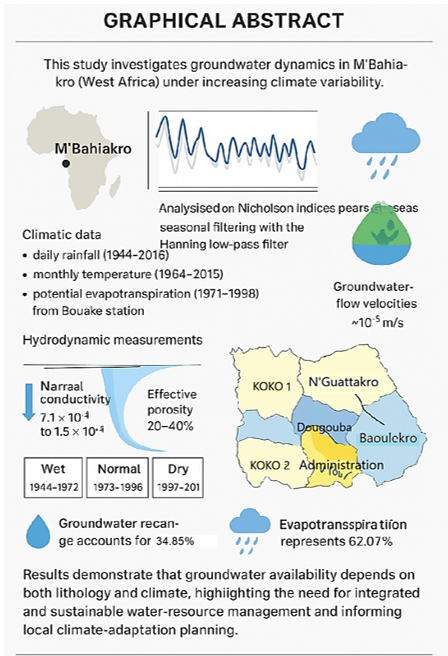
In the context of increasing climate variability in West Africa, this study analyzes groundwater dynamics in M’Bahiakro in relation to climatic conditions and aquifer characteristics. The data used include daily rainfall (1944–2016), monthly temperatures (1964–2015), and potential evapotranspiration (1971–1998) from the Bouaké station. The methodology combines the analysis of Nicholson indices after seasonal filtering using a Hanning low-pass filter. It also relies on hydrodynamic measurements of hydraulic conductivity, effective porosity, and groundwater flow velocities in four representative districts. The results identify three climatic phases: wet (1944–1972), normal (1973–1996), and dry (1997–2016), which directly influence aquifer recharge. Hydraulic conductivity ranges from 7.1 × 10⁻⁵ to 1.5 × 10⁻⁴ m/s, with permeable zones in N’guattakro and Koko and less permeable zones in Dougouba and Baoulekro. Effective porosity (20–40%) enhances water storage and infiltration in sandy areas but limits flow in clay-rich sectors. Groundwater recharge represents 34.85% of rainfall, while evapotranspiration accounts for 62.07%. Groundwater flow velocities, on the order of 10⁻⁵ m/s, indicate slow circulation and tend to decrease with declining rainfall and rising temperatures. These results highlight that groundwater availability depends on both lithology and climate, emphasizing the need for integrated and sustainable water resource management. They also provide critical information for local planning and climate adaptation, contributing to improved water-resource management in tropical environments.
Keywords: Climate variability, groundwater availability, groundwater table, water resources management, hydrogeology, M’Bahiakro, Côte d’Ivoire