GC-MS Characterization, Antioxidant Activities and in Silico Docking Studies of Essential Oil Components of Commiphora kerstingii Leaves
Lawrence Luka

Department of Chemistry, Adamawa State College of Education, Hong, Adamawa, Nigeria.
Chika Attama
*
Department of Pure and Applied Chemistry, Adamawa State University, Mubi, Adamawa, Nigeria.
Abdulrahman Ibrahim Kubo
Department of Pure and Applied Chemistry, Adamawa State University, Mubi, Adamawa, Nigeria.
Segun Gabriel Olanipekun
Department of Biochemistry, Federal University of Technology, Minna, Nigeria.
*Author to whom correspondence should be addressed.
Abstract
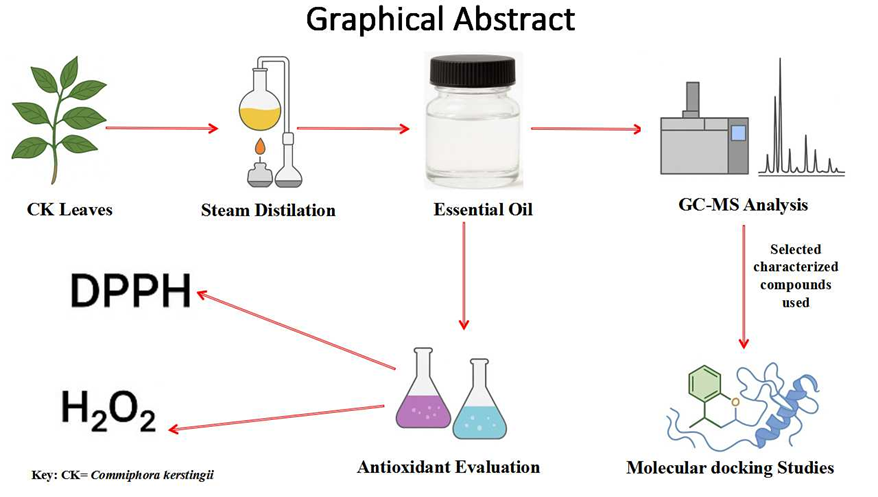
The present study investigated the chemical composition, antioxidant potential, and molecular docking properties of Commiphora kerstingii essential oil (CKEO). Gas chromatography–mass spectrometry (GC–MS) analysis identified 25 compounds, with α-phellandrene (55.06 %), α-pinene (33.62 %), γ-muurolene (42 %), santolina triene (23 %), and ylangene (4.06 %) as the predominant constituents. Antioxidant assays revealed that CKEO exhibited concentration-dependent inhibition of free radicals. In the DPPH assay, the oil demonstrated 42.11–59.90 % inhibition across 2.5–10 µL/mL with an IC50 value of 1.667 ± 2 µL/mL, while vitamin C achieved higher inhibition (52.56–90.40 %) at the same concentrations. Similarly, in the H2O2 scavenging assay, CKEO showed inhibition values ranging from 44.46–72.08 % with an IC50 of 2.849 ± 2 µL/mL, compared to vitamin C (79.13–90.12 %). The result of this study revealed that Vitamin C which served as the standard reference drug demonstrated high antioxidant properties over the essential oil in both bioassays. Molecular docking studies further revealed γ-muurolene as the most active ligand among the tested compounds, with the best docking affinity against 8WEJ (–93.6306 kcal/mol), 8U85 (–64.1925 kcal/mol), and 8GZ3 (–67.8085 kcal/mol) protein receptors interactions. Although quercetin, used as a reference compound, exhibited superior docking scores. The results of the docking studies highlight the pharmacological potential of CKEO constituents, particularly γ-muurolene, as promising leads for antioxidant and therapeutic applications. The findings suggest that the bioactive compounds of C. kerstingii essential oil could serve as valuable natural agents for drug discovery.
Keywords: Commiphora kerstingii, antioxidant activities, molecular docking, essential oil, bioassays